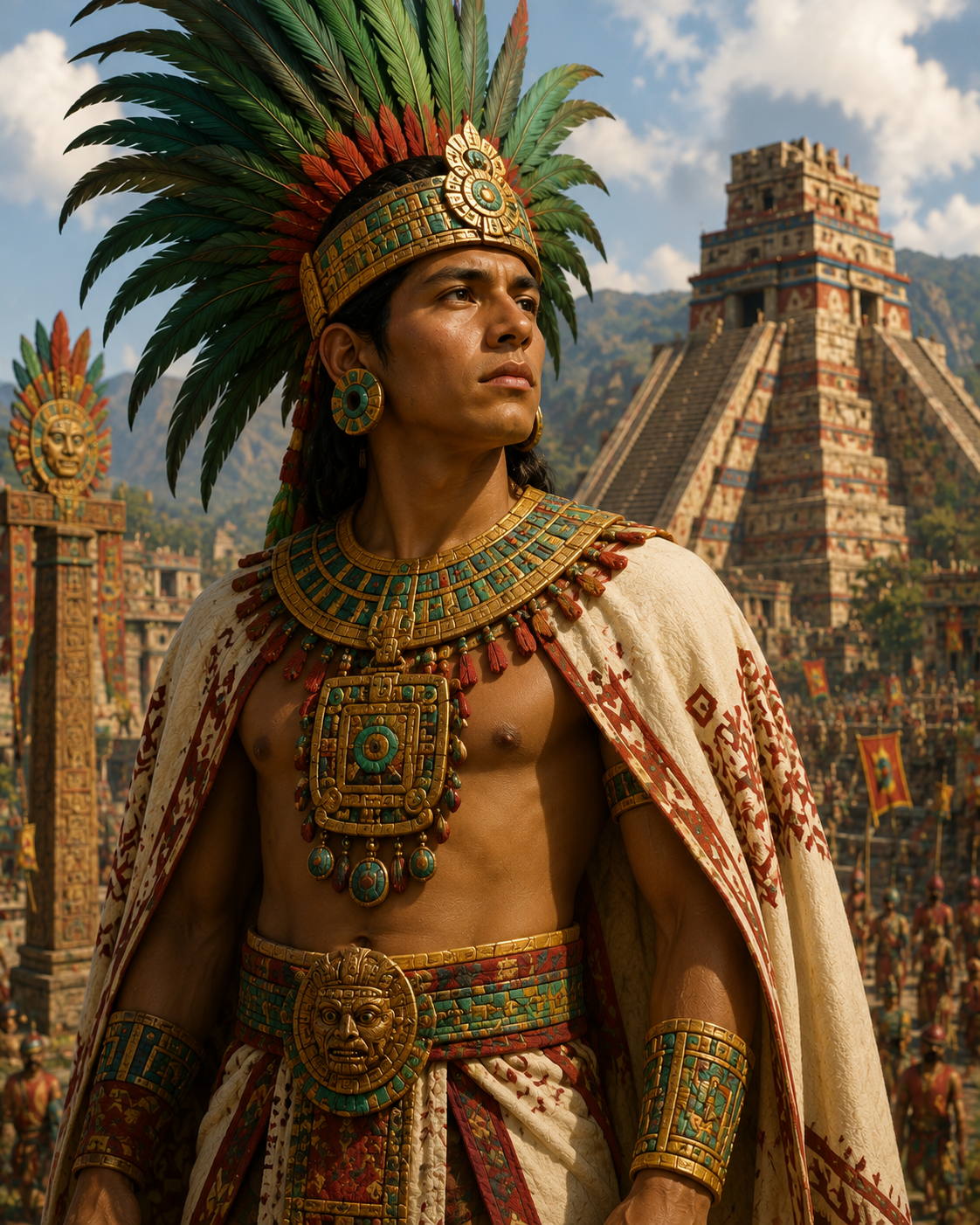
In this article we explore the major emperors of Mexico in chronological order, beginning with the rulers of the Aztec Empire and ending with the Second Mexican Empire in the nineteenth century.
Aztec Emperors
The Aztecs had emperors, who were the supreme rulers of their civilization. They had all the power in the Aztec city of Tenochtitlan. Each Aztec Emperor was chosen within the royal lineage by a council composed of a priest, warriors and nobles. Their reigns were passed on from brother to brother before passing on to the next generation.
Acamapichtli (1376–1395)
Acamapichtli was the first ruler of Tenochtitlan and established the royal dynasty that would govern the growing Mexica civilization. Under his leadership, the city expanded politically and economically while forming important alliances with neighboring city-states.
Legacy:
- Founded the imperial dynasty
- Strengthened agriculture through chinampas
- Laid the foundation for future expansion
Huitzilihuitl (1396–1417)
Huitzilihuitl continued strengthening alliances through diplomacy and marriage. Trade flourished, bringing wealth and prestige to Tenochtitlan.
Achievements:
- Expanded commerce
- Improved relations with neighboring kingdoms
- Increased tribute revenues
Chimalpopoca (1417–1427)
Chimalpopoca ruled during a politically unstable period. His reign ended under mysterious circumstances but prepared the way for the Mexica struggle against Tepanec domination.
Itzcóatl (1427–1440)
Often considered the founder of the Aztec Empire, Itzcóatl led the alliance that defeated the Tepanecs and created the Triple Alliance between Tenochtitlan, Texcoco, and Tlacopan.
Moctezuma I (1440–1469)
Moctezuma I transformed the empire into a dominant power throughout central Mexico. He expanded military campaigns and initiated major public works.
Major accomplishments:
- Defeated Azcapotzalco
- Created the Aztec Empire
- Began large territorial expansion
Axayácatl (1469–1481)
Axayácatl conquered additional territories and strengthened military power. During his reign, the famous Aztec Sun Stone may have begun construction.
Tízoc (1481–1486)
Although his reign was relatively short, Tízoc continued military expeditions and commissioned important monuments.
Ahuitzotl (1486 – 1502)
Ahuitzotl was the last Aztec king (tlatoani’ which means orator) actively building an Aztec Empire. Under his command the Aztec empire doubled in size. He was an aggressive military leader who expanded the Aztec Empire into Guatemala. During his reign the main temple of Tenochtitlan was rebuilt and completed.
He was the grandson of Montezuma and brother of Axayácatl and Tizoc.
Many historians consider Ahuitzotl one of the greatest Aztec rulers. Under his leadership, the empire reached its largest territorial extent.
Cuitláhuac (1520) Cuitláhuac was initially captured by the Spaniards. He was released and led his people to expel the Spaniards on June 30. Unfortunately, smallpox claimed the city, as it was a disease brought by the Spaniards. About 40 percent of the population died, and Cuitláhuac also died. He only ruled for four months. He was Montezuma’s nephew.
The last Aztec king (tlatoani’ which means orator)to be active in forming an Aztec Empire was Ahuizotl.
Moctezuma II (1502 – 1520) Moctezuma II was raised to be an Aztec Emperor from birth. He was a powerful and knowledgeable emperor, and a capable but demanding leader. He transformed Tenochtitlan into an imposing cultural metropolis. . It is believed that Tenochtitlan was one of the largest cities in the world.
Moctezuma II welcomed the Spanish conquistador Hernán Cortés. He believed in the legend of god-king, Quetzalcoatl, and thought that he had returned to fulfill the prophesy and reclaim his kingdom. The Spaniards ordered a great massacre and the Aztecs resisted. In 1520, in the midst of a bloody battle, Moctezuma II was killed by Cortés and his men. Moctezuma II was son of Axayácatl, great-grandson of Moctezuma I.

Cuauhtémoc (1520-1524)
Cuauhtémoc was the last of the Aztec emperors and considered the bravest of all. He fought bravely against the Spaniards in defense of Tenochtitlan. He was tortured and hanged by the Spaniards and died in 1524. Cuauhtémoc was the son of Ahuitzáotl, and nephew of Moctezuma and Cuitláhuac.

The Aztec Empire ended on August 13,1521. Its people were banished to the outside areas. Since then new civilizations have been built in most of the city.
Three centuries after the fall of the Aztec Empire, Mexico gained independence from Spain.
In the 1800’s, after its independence from Spain, Mexico was declared an independent empire.
Agustín de Iturbide (1821–23)
In May 1822, General Agustín de Iturbide was proclaimed Emperor Agustín I, by military groups. Known as Agustín I, he was crowned in a pompous ceremony in July 1822. As this was not accepted by both republicans and liberals, a conflict began between the military emperor and the civilian congress. In October 1822, the emperor dismissed congress and ruled through an appointed group. The act was condemned by many and in December 1822, he was forced to reconvene congress.
Then, he had to abdicate, so he escaped to Europe. When he returned to Mexico, he was apprehended four days later, arrested, and executed in July 1824.
In the 1850’s, Mexico was a very unstable nation; it was in debt and there were conflicts between conservatives and liberals.
In 1862, France invaded Mexico to collect payment of debts. By 1863, French forces were in command of Mexico. As a scheme between conservatives in Mexico who wanted to overthrow the President of Mexico, and Napoleon III of France, who wanted to legitimize French intervention and further imperialism, Maximilian was invited to rule a pro-French monarchy in Mexico.
Maximilian of Habsburg (1863-1864)
Maximilian accepted the offer of Mexican Emperor. He was led to believe that the Mexican people had voted for him. He received the support of the Catholic and conservative elite. However, contrary to their interests, he began to carry out liberal policies and to promote freedom of worship.
Maximilian was unable to unite Mexico and lost support. France withdrew its forces and Maximilian was left to his fate. By 1866, his armies were in disarray; and a civil war broke out. Yet, Maximilian stuck it out; and together with his generals, who never left him, were sentenced to death.

This last Mexican empire fell in 1867.
Author: AllMexico.store
References
Britannica, The Editors of Encyclopaedia. “Maximilian.” Encyclopædia Britannica, Encyclopædia Britannica, Inc., 8 Feb. 2019.
Wikipedia