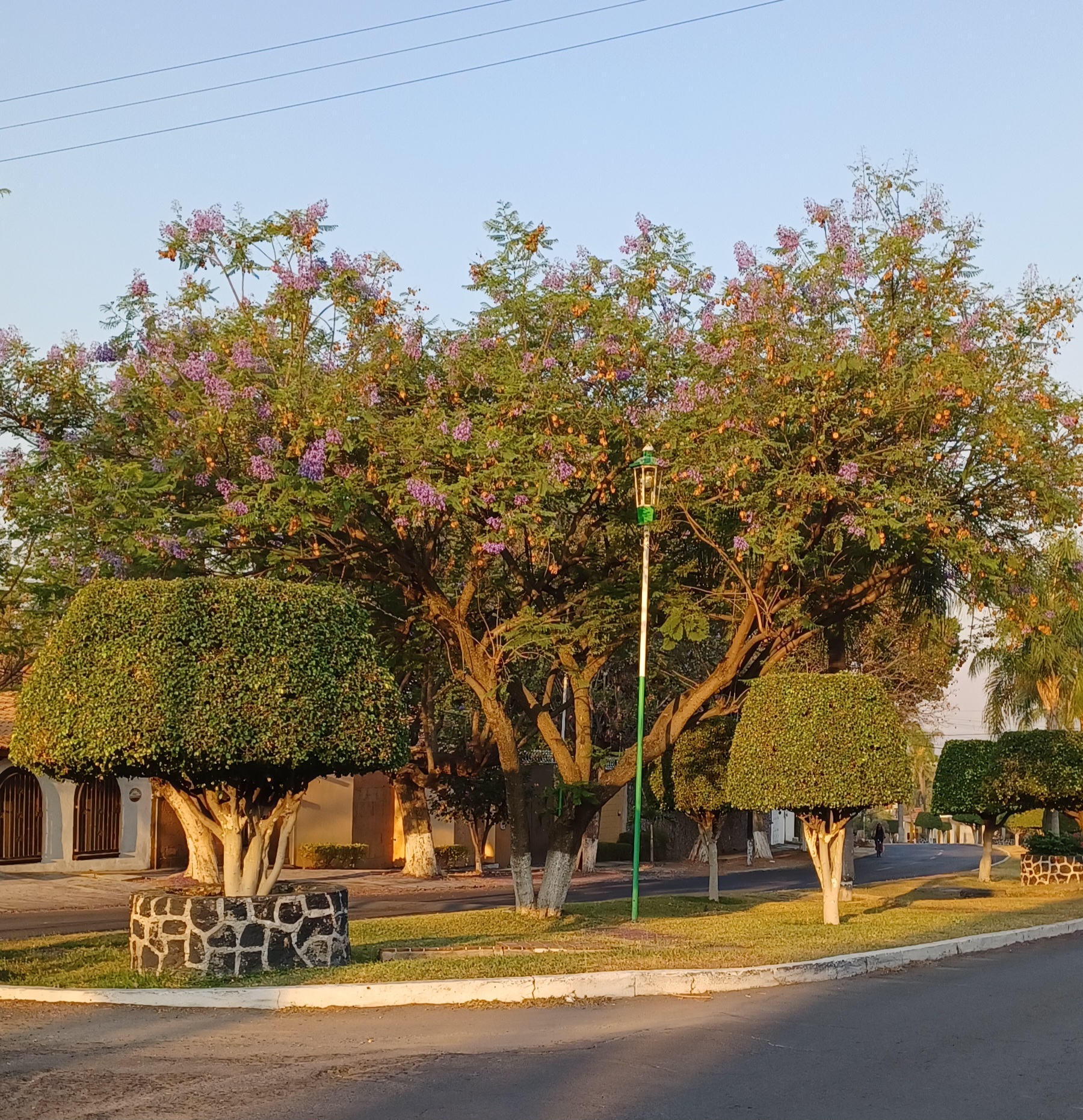
In springtime, flowering jacaranda trees can be seen in many parts of Mexico. On the ground, you can see purple- lilac-colored flowers on the ground. There are paths and paths. Interestingly, many cities in Mexico are dyed by the lilac color of the jacaranda flowers.
Characteristics of Jacarandas
Jacarandas grow as trees. They can measure up to 20 meters tall! There are different varieties, approximately among 120 species.
During spring and autumn, the trees flower. The flowers are purple-lilac color and measure about 2 inches. The leaves of the jacaranda are small, measuring about ¼ inch. The fruits are rod-shaped, with a woody appearance.
Generally, the jacaranda mimosifolia is the species you see in Mexico.

photo credit: Mexico Desconocido
The jacaranda tree is scientifically known as Jacaranda mimosifolia. The belongs to the family Bignoniaceae; a species of flowering plants that are characterized by having a “bell” shape. The trees grow mainly in South America in subtropical countries. Amazingly, jacarandas can live to more than 100 years.
Although jacarandas are considered by many Mexicans as maximum representatives of Mexico, due to their occupation of many decades, they are not native to Mexico.
Interestingly, Mexicans have acquired a special affection for jarandas. The jacaranda tree is appreciated in Mexico because of the visual beauty it provokes.
For most people, the jacaranda tree is pleasant to look at. Jacarandas have become a part of life in Mexico. In cities, the jacaranda tree is also an added value as a component of a green area. Another component is that, during rainfall, the canopy of the tree serves as a buffer for the soil, preventing erosion. Furthermore, the tree serves as a buffer in temperature changes and wind barrier.
In addition to being beautiful, the jacaranda tree also has medicinal benefits.
Invasive Jacarandas in Mexico
Despite positive contributions of jacarandas to the environment, they are considered an invasive species in Mexico. An invasive plant takes advantage of an imbalance in the environment and reproduces too much.
In the case of jacarandas, as they were introduced into the biodiversity of Mexico, they now alter ecosystems. They alter the network of interconnections with natural organisms of the area.
Unfortunately, jacarandas disrupt the dynamics of the animals, insects, bacteria, fungi and other native organisms in Mexico. As the species occupies more sites, natural ecosystems are disturbed. Multiplication of the species causes them to occupy more sites and disturb more ecosystems.
Furthermore, jacarandas limit the biodiversity in the area. Planted jacarandas take away physical space from native Mexican trees. Jacarandas also prevent the reproduction of native Mexican trees.
Often, roots of jacarandas break sidewalks, and their branches become entangled with light cables.

Arrival of Jacarandas in Mexico
Although there are various versions of the arrival of jacarandas in Mexico, it is believed that they were introduced by Japanese gardener Tatsugoro Matsumoto. Matsumoto and his son considered this a great idea, since the climate of Mexico City was perfect for the species. In the 1920’s, Matsumoto obtained the authorization of Mexican President Álvaro Obregón. So, jacarandas were planted to decorate the main streets of Mexico City. Thus, the arrival of jacarandas in Mexico is attributed to Matsumoto.
Author: AllMexico.store
Resources
UNAM Karla Angélica Castro Yáñez* andIvonne Guadalupe Olalde Omaña
Mexico Desconocido 5 lugares donde ver jacarandas en la CDMX – México Desconocido (mexicodesconocido.com.mx)