What is the Historic Center of Mexico City?
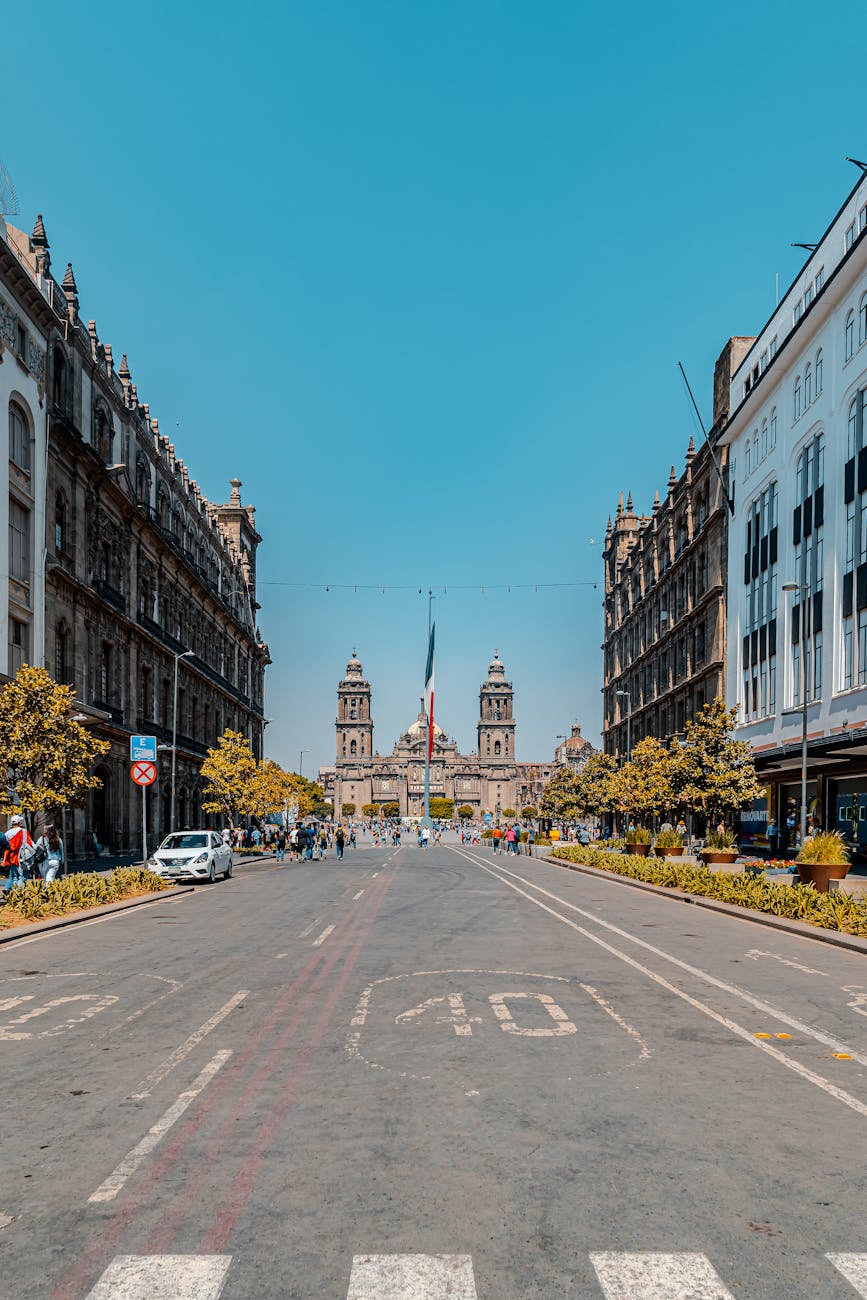
The Historic Center of Mexico City is the historic central neighborhood in Mexico City, Mexico. It is the largest historic center in Latin America. The main square in Mexico City, the Plaza de la Constitución, is popularly known as El Zócalo. It is one of the most iconic squares in the country of Mexico. The historic center has an area of about 47,000 square meters, including the streets within its perimeter.

Origin of the Historical Center of Mexico City
The original Mexico City was founded as a lake settlement on a small islet. Records date to 1325. The islet was surrounded by lakes, which were navigable and served as communication routes.
Known as Tenochtitlan, the city was constructed by the Aztecs in an orderly manner. In the 1500’s, Mexico City (Tenochtitlan) was an Aztec lordship. The Templo Mayor served as the central location of the Aztec Empire.
The Zócalo (main square) was part of the main islet and was oriented east-west. Streets and canals were aligned with cardinal directions. The city was divided into four calpullis (organized units of commoner housing), or neighborhoods. The center of the city possessed the Templo Mayor and palaces of nobility. The zócalo was surrounded by houses of Moctezuma, and houses of the tlatoanis.

Destruction of Tenochtitlan
After the fall of Tenochtitlan to the Spanish and its destruction, the Spanish laid out a new city. For the new city layout, the four calpullis (units of commoner housing) were maintained. The main square was reoriented in a north-south direction. The surrounding streets were laid out in a rectangular shape.
Colonial Mexico City Center
During colonial times, the Templo Mayor and the Palace of Moctezuma were demolished. The buildings of the Viceroyalty were built on the demolished ruins. The Viceregal Palace (the current National Palace) was built on what originally was the Palace of Moctezuma.
In 1657, the Cathedral was completed. The City Hall Palace was also built. Merchants filled the main square. Also, flooding was a common problem during this time. In 1629, the Plaza Mayor was submerged more than 2 meters.
Mexico City Center in the 1700’s
In 1789, the Cathedral and the main square were separated with an iron gate. The main square was leveled and repaved. During this restructuring, the Stone of the Sunand the sculpture of the goddess Coatlicue were found.
In 1813, the main square was baptized as Plaza de la Constitución (commonly called Zócalo).
In the 1930’s, through various decrees, this area was considered a Historic Center. Thus, the Zócalo, Moneda and important buildings were protected.
What makes up the Historic Center of Mexico City?
The sections of the historic areas in downtown Mexico City lie in the Cuautemoc borough. The Historic Center of Mexico City consists of 668 street blocks. Of the 9,000 buildings in the borough, 1,550 have been declared historical. Most of these buildings were constructed between the 1500’s and 1900’s.
For conservation purposes, the borough is traditionally divided into two zones. The first zone, Zone A, the one with the greatest cultural richness. 75% of the properties are catalogued as historical sites of world renown. This zone is made up of the Mesoamerican city of Tenochtitlan and its expansion from New Spain until Mexican Independence. It includes the Templo Mayor of Tenochtitlan, the Cathedral, the National Palace, the Old City Hall Palace, the Palace of Fine Arts and the National Museum of Art.

The second zone is Zone B, considered a buffer zone. This zone covers buildings to the end of the 1800’s. These buildings are important in the conservation of the architectural and cultural heritage of the historic center.
In its entirety, the Historic Center of Mexico City covers the “Centro”, neighborhoods ofboth zones, part of Guerrero, Buenavista, Tabacalera, Juárez, Roma, Doctores, Obrera, Tránsito, Esperanza, Merced Balbuena, Del Parque, 10 de Mayo, Escuela de Tiro, Penitenciaria, Ampliación Penitenciaria, Venustiano Carranza and Morelos neighborhoods.
The Importance of Mexico City Historic Center
The buildings of the Historic Center of Mexico City are important in its conservation of architectural,historical, and cultural heritage.
In 1978, the Aztec monolith that represents the Goddess Coyolxauhqui was found. As such, an Urban Archaeology Program began, whereby the Templo Mayor and other remaining buildings were located.
In 1980, the Historic Center of Mexico City was declared a Zone of Historical Monuments by presidential decree.
As such, the Historic Center of Mexico City has undergone numerous modifications throughout history. Also, the Zócalo has been the scene of important cultural and political movements. Currently, its present organization dates to 1958.
Today, the Historic Center of Mexico City represents the seat of Mexico’s religious and political powers.
What is the UNESCO description of the Historic Center of Mexico City?
On December 11, 1987, The United Nations Educational, Scientific and Cultural Organization (UNESCO) declared the Historic Center of Mexico City (and Xochimilco) as a Cultural Heritage of Humanity;
“Built by the Spanish in the 16th century on the ruins of Tenochtitlan, the ancient Aztec capital, Mexico City is today one of the largest and most populous capitals in the world. In addition to the vestiges of the five Aztec temples located so far, the city has the largest cathedral on the continent and beautiful public buildings from the 19th and 20th centuries such as the Palace of Fine Arts. Located 28 kilometers south of central Mexico, the site of Xochimilco with its networks of canals and artificial islands is an exceptional example of the Aztecs’ work to build a habitat in an environment hostile to man. The urban and rural structures created from the sixteenth century during the colonial period have been admirably preserved.”
Visit the Historic Center of Mexico City
Visitors to the Historic Center of Mexico City can look forward to the following:
- Metropolitan Cathedral of Mexico City
- National Palace (Sseat of the executive power and presidential house)
- Old City Hall Palace (Office of the head of government of Mexico City)
- Government Building (Mexico City Government Offices)
- Old Portal de Mercaderes
- Hotel Zócalo Central
- Museum of the Templo Mayor

Visitors can spend more than a week exploring the neighborhoods in the Historic Center of Mexico City.
Author: AllMexico.store
References
Fideicomiso Centro Histórico de la Ciudad de México
Learn about other UNESCO World Heritage Sites in Mexico.