What is the Aztec Calendar (Aztec Sun Stone)?
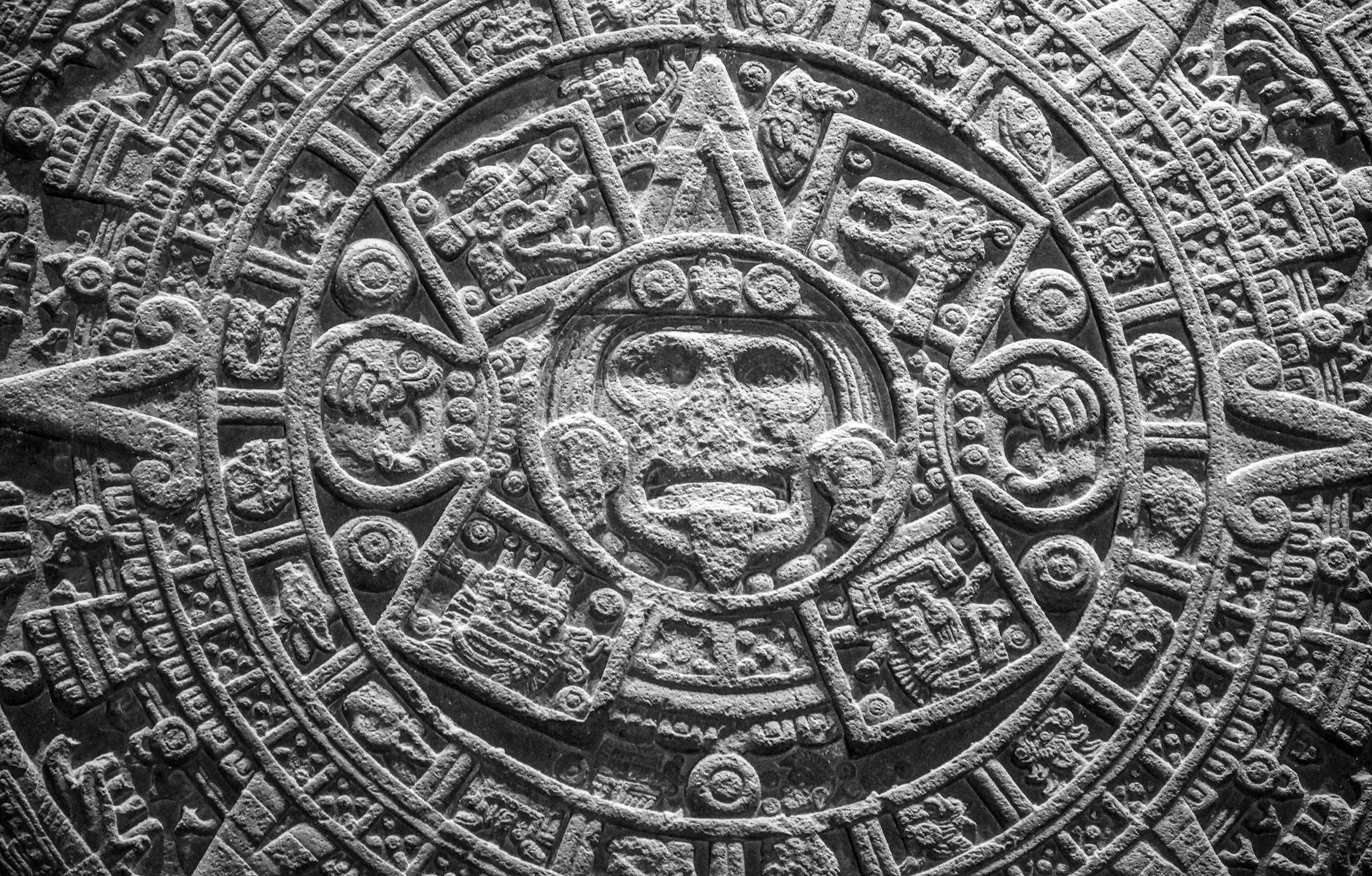
The Aztec Calendar, also known as the Aztec Sun Stone, is a circular monolithic stone that encompasses a series of inner circles with carvings. The composition of the stone is of olivine basalt with a weight of around 24 tons. The stone measures 3.6 meters in diameter.
It is considered that the carvings within the stone are related to a design of astronomy, time, and cycles of months. The Aztec Sun Stone details the astronomical, historical, religious knowledge and social organization of the indigenous people of that time.
The Aztec Calendar was found on December 17, 1790.

Location of the Sun Stone
During remodeling of the square in Mexico City, workers were digging and found the stone in an area near a ditch along the south side of the National Palace. Its location was on the south side of the Plaza Mayor in Mexico City.
History of the Aztec Sun Stone
Early Period of the Sun Stone
The origin of the Aztec Sun Stone is not known. However, it is thought by some scientists that the monolith was carved between 1250 and 1521 AD.
In 1094, the idea of a design of a circular plan made up of several rings was presented by Toltec artisans. Here, the days and months of the year would be carved.
In the lates 1300’s, the work began under the Mexica Emperor Itzcoatl (1381-1440).
The elaboration of the Sun Stone may have taken place during the last stage of the Aztec splendor empire.
Under Spanish dominion, the Sun Stone was considered pagan. As such, it was moved to the back of the Templo Mayor and forbidden to the indigenous people.It has been said that indigenous survivors protected its design with a layer of volcanic ash or sand, thus saving it from imminent destruction.
At the end of 1550, the monolith was buried, by order of the Archbishop.
As such, the Sun Stone remained buried for about 200 hundred years.
Finding the Sun Stone
In 1790, workers reported that a sculpture with symbols had been found.
In 1791, after various debates, the Sun Stone was placed in the Metropolitan Cathedral. At this moment, the monolith was referred to as the Aztec Calendar.
In the 1800’s, armies from the United States arrived in Mexico City. They found the circular monolith inside the Metropolitan Cathedral. They then transported it to a square. Cracks in the monolith were caused by this transport.
In 1855, the Sun Stone was transferred to the Archaeological Museum.
In 1964, the monolith was placed in the National Gallery of Anthropology and History.
The Aztec Calendar (Sun Stone) has been studied extensively. A summary follows with regard to its function, position, and symbolism.
Function of the Aztec Sun Stone
Historically, the function of the Aztec Calendar (Sun Stone) has been widely discussed. Some interpretations of its function present it as a portrayal of the passage of time, a guide to the distribution of time, and as a platform of combat.
As a guide, it may have served early indigenous people as a sort of map to follow in order to know the “correct” days for cultivation, harvests, rituals and war, in an effort to follow a stable order.
Thus, two annual cycles were possible. The Aztec Xíhuitl 365-day solar cycle contained 18 months of 20 days. It was used for marking the seasons and planning festivals. During the remaining 5 days, the new year was welcomed, and penances were completed. The Aztec tonalpohualli 260-day calendar combined the numbers 1-13 with 20 names of animals and objects. Each day name was denoted by a symbol, and each number was denoted as a dot.

Original position of the Aztec Sun Stone
When found, the monolith faced downwards. At that time, chroniclers believed the position of the Aztec Sun Stone must have been horizontal and that it was named Xihuitl (solar period).

Symbolism of the Aztec Sun Stone
Most scientists agree that the Aztec Calendar (Sun Stone) is a solar calendar, a complex calendrical support. As such, its symbolism may then be based on events that occurred eras prior to Aztec dominion. These include earlier astral perceptions of the Toltecs, and a worldview of the Mexicas. Thus, two perceptions of time that are interlocked can be observed; time that cannot be altered which is driven by the gods, and time that is in constant motion, imperfect.
Through this symbolism, each figure portrayed within the circles reflects the order of the world according to time, which describes the destiny of the human cycle. Symbolically, it portrays how life and the end of the earth was, is, and will be.
Characteristics of the Aztec Sun Stone
A summary of the characteristics of the Aztec Calendar follows.
To start, the sculptured stone has a circular arrangement resembling the sun. The structure of the Aztec Sun Stone is cyclical and is made up of five stratums.
The succession of the concentric rings arranged within the monolith contain elements that are related to time; the number of days contained in a year, the length of the months, and the duration of centuries are described.
Central disc
In the center of the monolith, a face is carved that has a tongue shaped like a dagger. The identify ensues discussion. The deity may pertain to the underworld, to the earth, or it is the night Sun deity, Tonatiuh.
Tonatiuh was known to the Aztecs as the fifth sun diety ( tona: to make sun, tiuh: to go) who was the leader of the sky. The dagger is a symbol of the sacrifice that had to be offered to the sun deity to feed him. He was reborn every day in the east (dawn), after his journey to the underworld (dusk).
The earmuffs are considered signs of learning.
The headdress shows the development of the pineal gland.
The head holds a type of tiara.
The torso is adorned with pearls, which represent the duality of the universe.
The hands are shaped like jaguar claws and hold two human hearts.
There are also stripes and points. These represent the four directions and movements of the sun.
The Circles of the Sun Stone
The First Circle
Starting with the first circle, there are 20 carved figures. These represent the 20 days of the year calendar. They are; The Alligator (Cipactli), Wind (Ehécalt), The House (Calli), The Lizard (Cuetzpalin), The Serpent (Coatl), The Skull (Miquiztli), The Deer (Mázatl), The Rabbit (Tóchtli), Water (Atl), The Dog (Izcuintli), The Monkey (Ozomatli), The Herb (Malinalli), The Cane (Acatl), The Jaguar (Ocelotl), The Eagle (Cuauhtli), The vulture (Cozcacuauhtli), The Tremor (Ollin), The Flint (Tecpatl), Rain (Quiahuitl), The Flower (Xochitl).
The Second Circle
Then the second circle, which has a series of square sections containing five dots. These dots represent the days.
The Third Circle
The third circle has the jaws of two fire serpents (Xiuhcoatl). These face each other at the bottom.
The Fourth Circle
The fourth circle has the stars of the night sky. There are 58 small circles that end in bands of amate paper (amatl).
Lastly, there is debate as to the completion of the Aztec Sun Stone. It is believed to have been completed in 1479. It may be possible that the Aztec Sun Stone sculpture is not finished.
Author: AllMexico.store
Piedra del Sol (calendario solar).