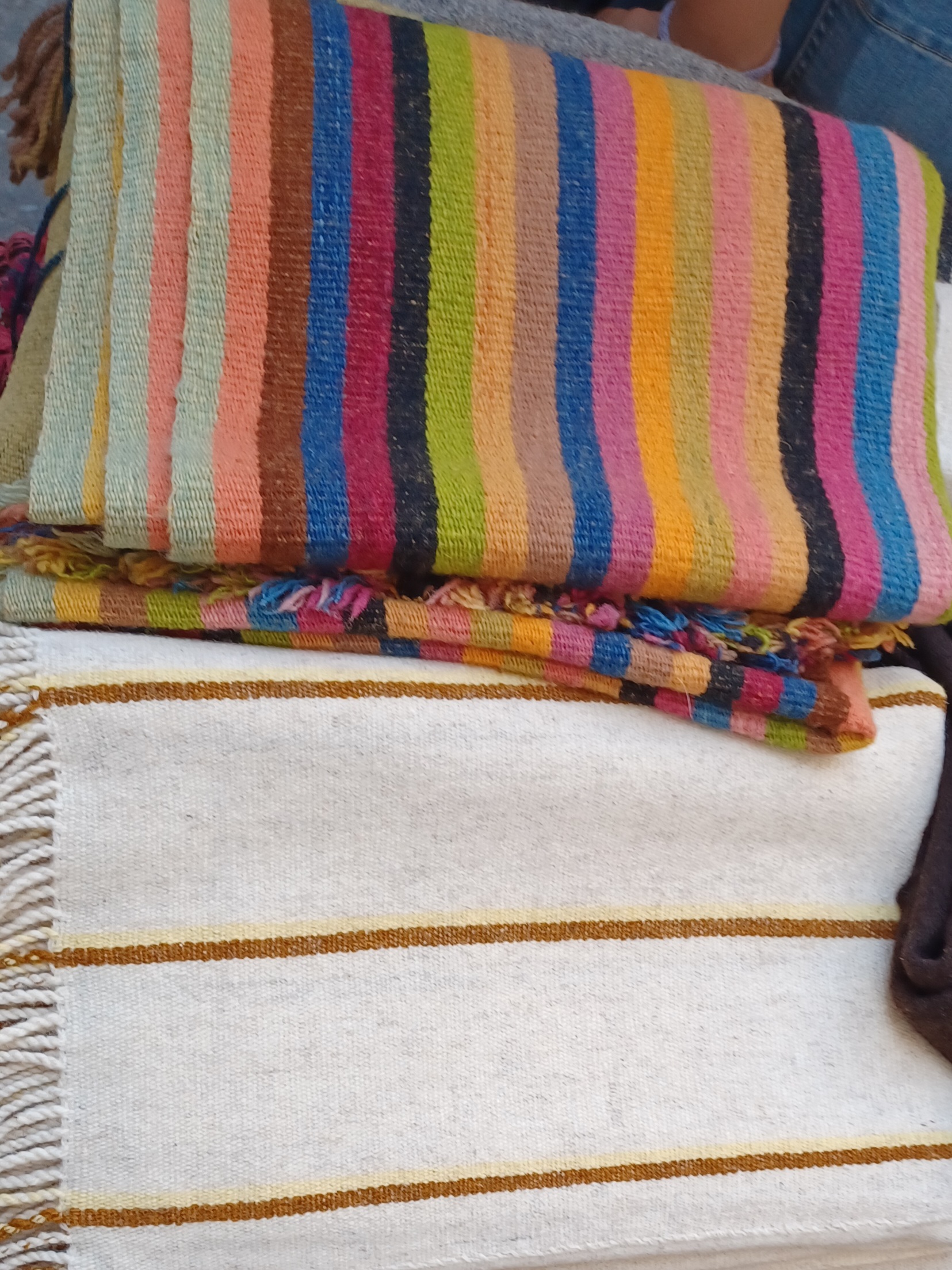
In the community of Hueyapan in the state of Morelos, many members are respectful and conservative of their original worldview. Furthermore, through ancestral knowledge, the community has continued the creation of textiles. In this community of Hueyapan, one of the main activities of many women is the production of woven textiles, including shawls, gabanes, belts, and rebosos.
Currently there are approximately more than a dozen groups of weavers who keep this beautiful tradition alive. They carry out an artisanal process of producing textiles, a tradition of about 400 years.
The principal features of the textile works of the community of Hueyapan are antiquity and distinct techniques and materials. The women weavers use traditional techniques of dyeing, weaving, and embroidery.
Hueyapan Textiles
Historically, young girls first observed and played with the yarn and threads, then were increasingly involved in spinning and weaving. Their mother passed on the teachings. Their work was considered a divine gift, and social hierarchy did not matter.
The textile production of the Nahuas of Hueyapan is an extraordinary example of the cultural diversity preserved for generations. It allows the women to obtain an economic livelihood for the families and groups of weavers in the community.
These women not only design clothing and textiles. They also rescue original models, both in form and in symbology.
Textiles, including shawls and belts, are spun manually. The support is woven on a backstrap loom.
The threads used are dyed with natural dyes in various shades. Wool is used.
Flora and the Dyeing Process
Another point of importance within the textiles of Hueyapan is the extensive knowledge of the flora of the community, and their protection by the community. A diverse number of plants are used to dye the materials. Traditional techniques are used in dyeing.
The women point out that the consumption of plants for the artisanal process does not drastically affect the ecosystem, helping the balance in vegetation. They use only what they need. A conservation practice on their part that is characteristic of knowing how to value mother earth.
Among the dyeing plants used are arnica (Arnica montana) and marigolds (Tagetes erecta) that give yellow tones; Green Teshuat (Miconia mexicana) and Brown Teshuat (Miconia sp.) provide brown tones; Cedar (Cupressus lusitánica) and Elderberry (Sambucus nigra) provide a green color.
Some of the plants used by women weavers of Hueyapan in the preparation of natural dyes.

Ancestral knowledge in the preparation of other shades such as chedron, pink, and black is in danger of disappearing.

Folded artisan made shawls. These shawls are made by women weavers of the community of Hueyapan, in the state of Morelos.
Conservation and Cultural Heritage
Textiles such as shawls and gabanes from Hueyapan can be considered the heritage and identity of this community, as there is conservation of ancient practices and intangible knowledge accumulated over generations.
Unfortunately, there has been little effort to preserve this ancient artisanal process and artistic representations. Artistic representations from the community of Hueyapan have been commercially abused. Both by craft galleries from Mexico and abroad. Dealers buy the textiles in the Hueyapan community at low prices, then resell in airport and commercial stores for many times over the price they paid.
The community has also been targeted by fashion designers who offer projects to artisans, projects that are usually disproportionate and that generate false paradigms.
This artisanal process must be protected and respected. The efforts shown by the community, through different actions, demonstrate the leading role they have taken in their heritage assets.
Regarding the textiles of the community of Hueyapan, theirs is a cultural right to heritage that presents more emphasis in seeking to protect these legacies. The community of Hueyapan continues with efforts to exhibit their works.
Recognition of the identity value of their heritage asset, such as the chales of Hueyapan, includes planning of strategies, such as workshops and information sessions, mainly for younger generations. The artisans continue to promote the immersion of new generations in textile production.
Also, with much effort, the artisans attend fairs, exhibitions, and cultural exchanges in Mexico and abroad.

All textiles are created using natural fibers and dyes.
The artisanal works of Hueyapan weavers have been exhibited in fairs in New York City, and Los Angeles.
Here is contact information for these weavers from Hueyapan.
Muchas gracias Damaris, Mariella y Lucero.

Author: AllMexicoStore.com
References
Becerril Miro José Ernesto (2012) “Cultural heritage, human rights and development: coincidences, ambiguities and disagreements” in Intervención International Journal of Conservation, Restoration and Museology. National Institute of Anthropology, Mexico City
The human and social right to cultural heritage (2016). Spinor Journal of the Vice-Rectory for Research and Graduate Studies.
Did you know?
According to the research on textiles in Mexico, one of the main forms of production of fibers for textiles was made possible through the use of clay winches or tzotzopaztlis. Cotton and ixtle were the common raw materials that were dyed.
Learn about Traditional Textiles from the state of Guerrero.