In Mexico, the Spring equinox is an important annual astronomical phenomenon. The event occurs due to the axis of the rotation of the Earth. Due to a tilt of 23.5 degrees, equinoxes and seasonal changes occur. Furthermore, different parts of the Earth receive direct rays from the Sun during the year.
At Spring Equinox, the Sun aligns directly on the celestial equator, marking anequal number of hours of daylight and night. Day and night last the same. From that moment on, the days become longer and brighter.
As Mexico is in the northern hemisphere, it is a region that receives a greater amount of sunlight.
In ancient Mexico, the equinoxes were considered events of vital importance.
Today, there is meaning that is related to this perfect balance of day and night, for some people. For them, this gives way to hope for renewal of positive energy with the arrival of the season.
As such, for Spring Equinox, hundreds of people gather at some of the main archaeological sites in Mexico.
When does the Spring Equinox 2025 occur in Mexico?
In Mexico, the Spring Equinox for this 2025 will occur on Thursday, March 20, at 4:01 a.m., Mexico central time.
The Spring Equinox Experience in Mexico
Amazingly, the spring equinox can be experienced in various sites in Mexico!
Below, we list some archaeological sites in Mexico to experience the Spring Equinox.
Teotihuacán Archaeological Zone
The Teotihuacán Archaeological Zone is driving distance from Mexico City. At the Palace of Teotihuacán there is a painting on which a shadow is projected. Accompanied by a series of mica mirror-like circles, sunlight was received and flashes thrown onto the unlit part. From this effect emerges a stepped fretwork, which presents the path of the shadows on a serpentine figure. The figure is a xicalcoliuhqui, presented as a naturalistic form of a serpent. Amazingly, the effect occurs with precision on the day of the equinox.
In the Teotihuacan complex, a probable solar observatory is also noted, with decorative figures that are probably an astronomical and architectural setup. The solar observatory was used to determine agricultural dates or other events of importance.

AllMexico.store photo credit
Cuicuilco Archaeological Zone
The Cuicuilco Archaeological Zone is located within the vicinity of Mexico City. Cuicuilco was a Mesoamerican astronomical center of great importance. Through the layout of the complex, its orientation is fundamental. Its architecture allows for trajectories to be observed and positions in the sky to be fixed, from nearby hills and other topography. As such, a deep knowledge of astronomy may be conveyed through the architectural orientations related to astronomical alignments within the landscape.
A circular pyramid was also built that was aligned with the celestial movements. The pyramid has two equidistant ramps. It is thought that possibly both point towards the equinoxes.
Xochicalco Archaeological Zone
The Xochicalco Archaeological Zone is in the state of Morelos, also driving distance from Mexico City. Xochicalco was an important Mesoamerican settlement. As such, important ceremonies and celestial observations were held there.
In Xochicalco there are vestiges of several observatories. A highlight of Xochicalco is that it has different caves that were created for specific purposes.
Considered the most important, La Cueva, is located in a cave of a main structure. Due to its geographical location, astronomers had the opportunity to study solar movements and other celestial evolutions. The observatory was of great value, especially during the spring equinox. There is an 8-meter deep chimney, through which the interior of the cave receives a unique ray of light. This allows for luminosity and surprising light effects.

In ancient Mexico, the equinox at Xochicalco was defined by priests in their observations of the sunbeam that passed through the observatory. It was considered the zenithal ray of the spring equinox, the key to control of the agricultural cycle.
Furthermore, the most representative structure of Xochicalco during equinox, is the pyramid of Quetzalcoatl. This temple was dedicated to Quetzalcoatl, the feathered serpent. During spring equinox, due to the alignment of the sun, the effects are seen as a silhouette of a serpent descending the steps of the great pyramid.
Without a doubt, Xochicalco is known for its significant number of astronomical references. Its main structures are based on the alignment of astronomical bodies, in relation to the most relevant visible bodies.

AllMexico.store photo credit
Chichén Itzá Archaeological Site
Chichén Itzá is a well-known Archaeological site, located in the state of Yucatan. Chichén Itzá is famous, as it was the capital of the ancient Itza Maya.
According to researchers, the Mayan civilization had a deep knowledge of seasonal and astronomical changes. The ancient Mayans were specific in the indication of the equinoxes, through their astronomical observations and architectural structures. The ancient Mayans predicted the dates of the equinox with accuracy. Also, they oriented their buildings to point toward the equinoxes such that a beam of sunlight would pass through windows.
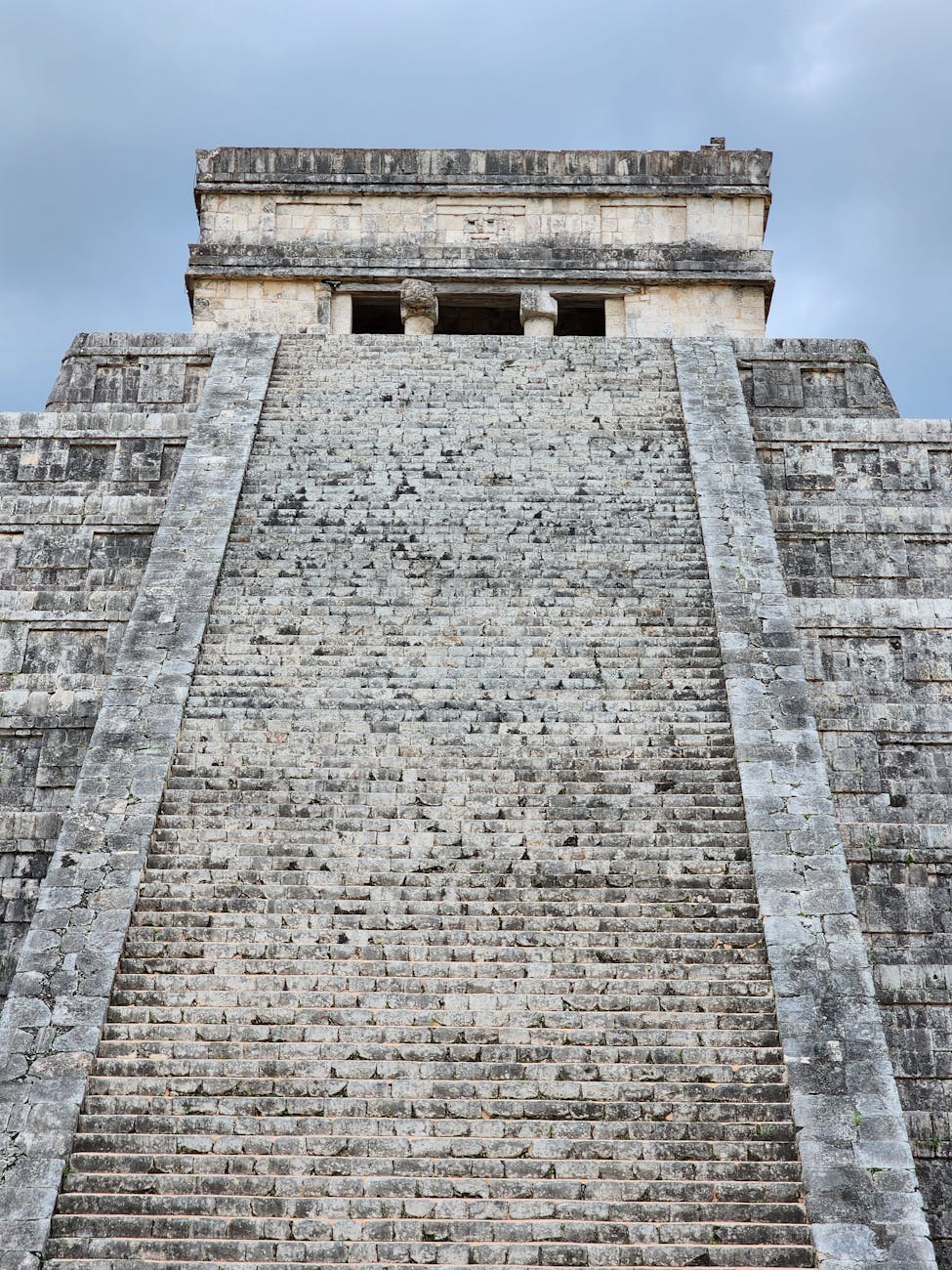
During the equinox, at one of the corners of the Temple of Kukulkán, a spectacular event takes place. The famous descent of Kukulkan (Feathered Serpent) can be observed. Amazingly, the effect appears as a serpent shadow. With the movement of the Sun, the serpent shadow descends through the corner bases of the temple to the foot of the temple stairs. Here, a huge serpent’s head is located. The shadow figure is projected for about 30 minutes.
This year, in Chichén Itzá, the Spring Equinox will occur on March 20 at 03:01 in the morning in (Mexico Central time). With its Mayan ruins, Chichén Itzá is most likely, the most visited site to experience the Spring Equinox.

© Wikipedia.
Tulum Archaeological Site
The Tulum archaeological site, also known as the Tulum ruins, is located on a cliff on the coast of Quintana Roo.
Tulum faces the sunrise. Its excellent conservation consists of a contained site with structures and mural paintings. It has five entrances and two watchtowers. Its Mayan temples and structures indicate that Tulum functioned as an astronomical observatory. Here, the ancient Mayans used the equinoxes as indicators for when to plant and harvest crops.
Tulum is considered one of the best places to experience the equinox.
Author: AllMexico.store
References
Mexico Desconocido Equinoccio de Primavera en Chichen Itzá, el espectáculo de luz que no debes perderte – México Desconocido
Did you know?
The equinoxes take place twice a year, when the Sun passes halfway through its orbit, through the center of the Earth’s equator. The Spring Equinox takes place between March 19 and 21. Spring arrives at this time in the northern hemisphere, while autumn arrives in the Southern Hemisphere.
The Fall Equinox takes place between September 22 and 23. Spring enters in the southern hemisphere and autumn arrives in the northern hemisphere.

Chichen Itza AllMexico.store photo
Leave a Reply